Kingdta
How to Reduce GPS Tracker Power Consumption with Motion Wake-Up Sensors
HomeBlogHow to Reduce GPS Tracker Power Consumpt...
Application Guide

How to Reduce GPS Tracker Power Consumption with Motion Wake-Up Sensors

Learn how motion wake-up sensors reduce power consumption in GPS trackers. Improve battery life with ultra-low-power vibration sensor solutions.

Apr 3, 20269 min readView Product

1. Introduction

Power consumption is one of the biggest challenges in low power GPS tracker design, especially for battery-powered devices used in vehicle tracking, asset monitoring, and logistics applications.

In real-world scenarios, most GPS trackers remain stationary for long periods and only need to activate when movement occurs. This makes motion detection a critical factor in optimizing battery life.

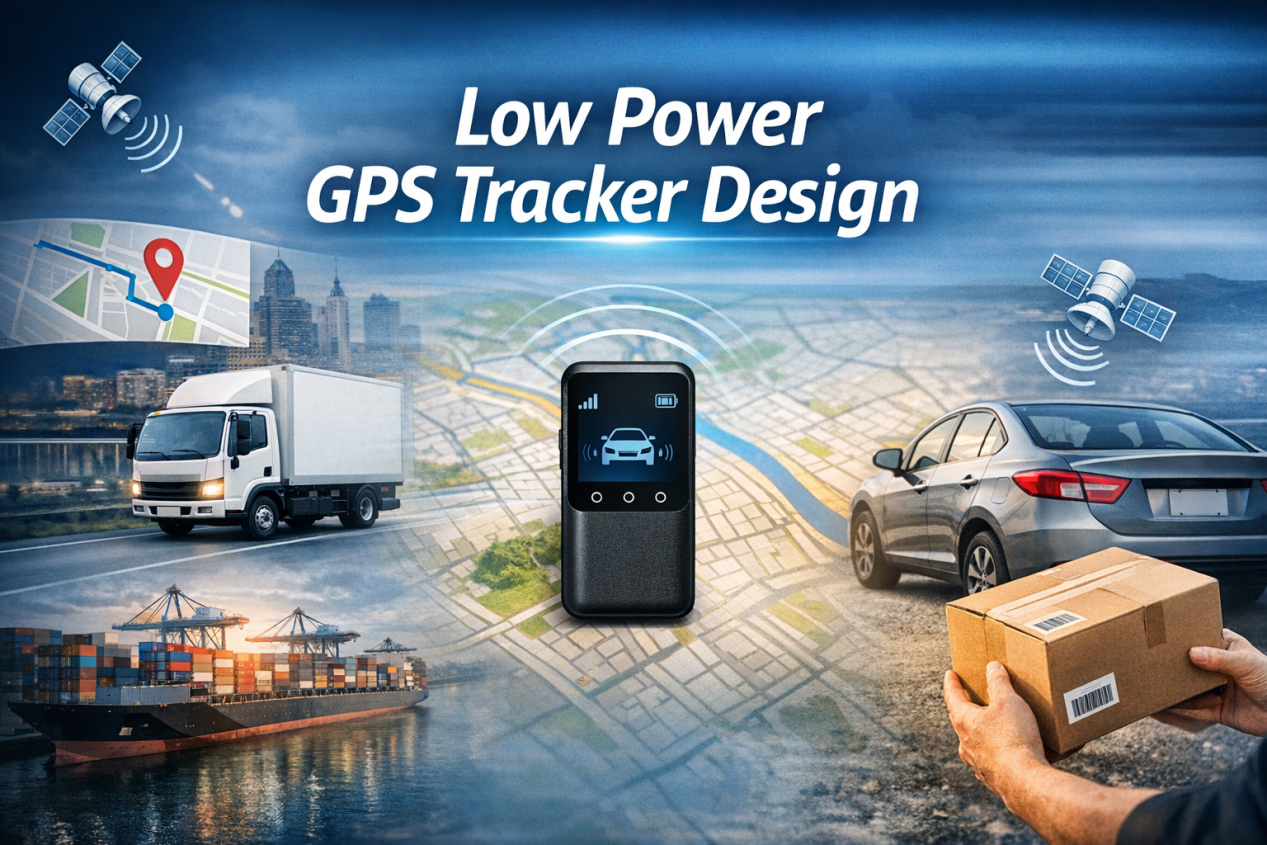
Low power GPS tracker and motion wake-up concept
Motion wake-up sensing helps GPS trackers stay in deep sleep until real movement occurs.

2. The Limitation of Traditional Motion Detection

Most GPS tracking devices rely on MEMS accelerometers for motion detection. While these sensors provide accurate data, they introduce several challenges:

• Continuous power consumption (typically in the microamp range)

• Dependence on MCU processing

• Increased system complexity

• Higher overall cost

Even in low-power modes, accelerometers still consume energy, which reduces overall battery life in long-term deployments.

3. A Different Approach: Motion Wake-Up Sensors

Instead of continuously monitoring motion, an alternative is to use a motion wake-up sensor based on vibration detection.

This approach allows the system to remain in deep sleep and only wake up when real movement occurs.

A passive vibration sensor from our Sensor Modules family can function as a hardware trigger, generating a signal only when motion is detected—without consuming meaningful standby power. Browse passive vibration switches on the Sensor Modules page for model lineup and specs.

FeatureAccelerometerVibration Sensor
Power ConsumptionContinuousNear Zero
MCU RequiredYesNo
CostHigherLower

4. How the Vibration Sensor Works

A vibration-based wake-up sensor uses a simple mechanical structure:

• In a static state, the circuit remains open.

• When vibration occurs, internal contact generates pulse signals.

• These pulses can directly trigger the MCU via a GPIO interrupt.

This eliminates the need for continuous sensing and enables true ultra-low-power system design.

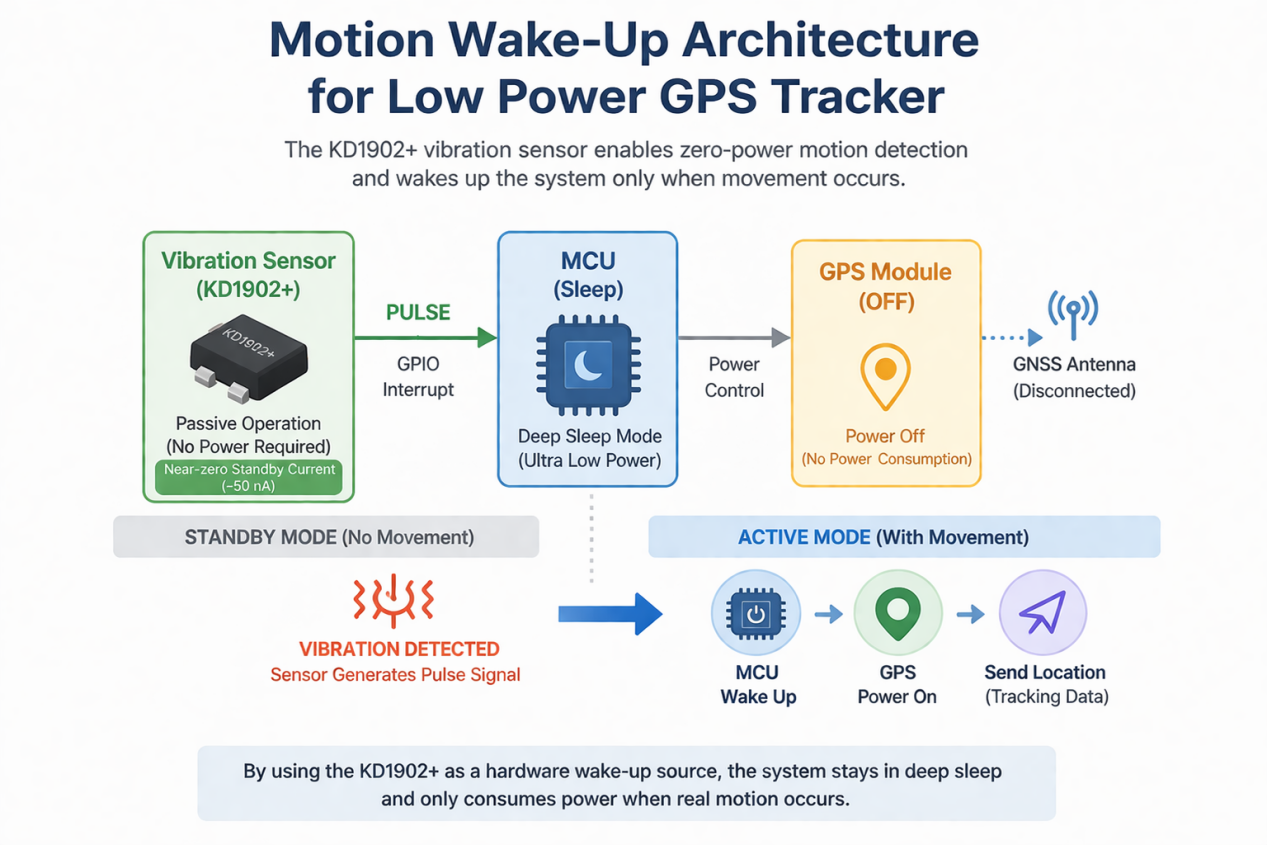
5. Example System Architecture

In a typical low power GPS tracker design:

• Vibration sensor → connected to MCU GPIO (interrupt input)

• MCU → remains in deep sleep mode

• GPS module → powered off during standby

When motion is detected: the sensor outputs a pulse signal → the MCU wakes from sleep → the GPS module powers on for positioning. This architecture ensures that energy is only consumed when necessary.

GPS tracker block diagram with vibration wake-up
Example signal path: vibration interrupt wakes the MCU before the GPS subsystem turns on.

6. Key Benefits for GPS Tracker Design

By using a hardware-based motion wake-up approach, designers can achieve:

Ultra-low power consumption — The sensor itself consumes near-zero standby current, ideal for battery-powered systems.

Extended battery life — The system only activates when motion is detected, minimizing unnecessary energy usage.

Simplified design — No need for I2C/SPI interfaces or continuous MCU monitoring for basic wake-up.

Cost optimization — Lower cost compared to many MEMS-based motion detection solutions.

Reliable motion detection — Omnidirectional sensitivity helps detection regardless of device orientation.

7. Typical Applications

This solution is widely used in:

• Vehicle GPS trackers

• Asset tracking devices

• Logistics and cargo monitoring systems

• Anti-theft tracking solutions

• Portable IoT tracking devices

8. Recommended Device

One example of a motion wake-up sensor is the KD1902+ omnidirectional vibration sensor, designed for ultra-low-power applications.

Key features include: near-zero standby current (~50 nA), passive operation (no power supply required for the sensing element), direct pulse output for MCU wake-up, compact SMD package, and 360° motion detection.

For full electrical, mechanical, and reliability data, download the KD1902+ datasheet from the link below, open the KD1902+ section on Sensor Modules, or read the KD1902+ product article on our blog.

9. Conclusion

Optimizing power consumption is essential for improving the performance and competitiveness of GPS tracking devices.

By replacing continuous motion sensing with a hardware-based motion wake-up sensor, designers can significantly extend battery life while simplifying system architecture.

This makes vibration-based wake-up solutions an effective choice for next-generation low power GPS tracker designs.

Looking for a reliable motion wake-up sensor for your GPS tracker design? Feel free to contact us or request samples to evaluate how this solution can improve your device battery performance.

Interactive Demo

Download the Product PDF

Get the corresponding specification sheet for this article.

Download PDF

Need a motion wake-up sensor for your GPS or asset tracker design?

View KD1902+