1. Introduction
Battery life is one of the most critical design challenges in modern IoT devices. Many products such as asset trackers, smart locks, wearable devices, and wireless sensors are expected to operate for months or even years without frequent battery replacement.
However, traditional motion detection methods often rely on active electronic components such as MEMS accelerometers or gyroscopes. While these sensors provide precise motion data, they also require continuous power consumption.
Mechanical vibration sensors offer a simple and ultra-low-power alternative. By acting as a hardware trigger, they allow IoT systems to remain in sleep mode most of the time and wake up only when motion occurs. This approach significantly extends battery life while maintaining reliable motion detection.
As IoT deployments continue to expand across industries, vibration sensors are becoming an increasingly valuable component for engineers designing energy-efficient systems.

2. Why Battery Life Is Critical in IoT Devices
Unlike traditional electronic devices that are connected to constant power sources, many IoT systems rely entirely on battery power.
These devices are often deployed in locations where frequent maintenance is impractical. In large-scale deployments, replacing batteries regularly can dramatically increase operational costs.
For example:
• asset tracking devices used in logistics
• wireless environmental sensors
• smart building monitoring systems
• wearable electronics
• agricultural IoT sensors
In such applications, battery lifetime directly influences the success of the product.
Engineers often aim to design devices that can operate for one to five years on a single battery. Achieving this goal requires minimizing energy consumption across every component in the system.
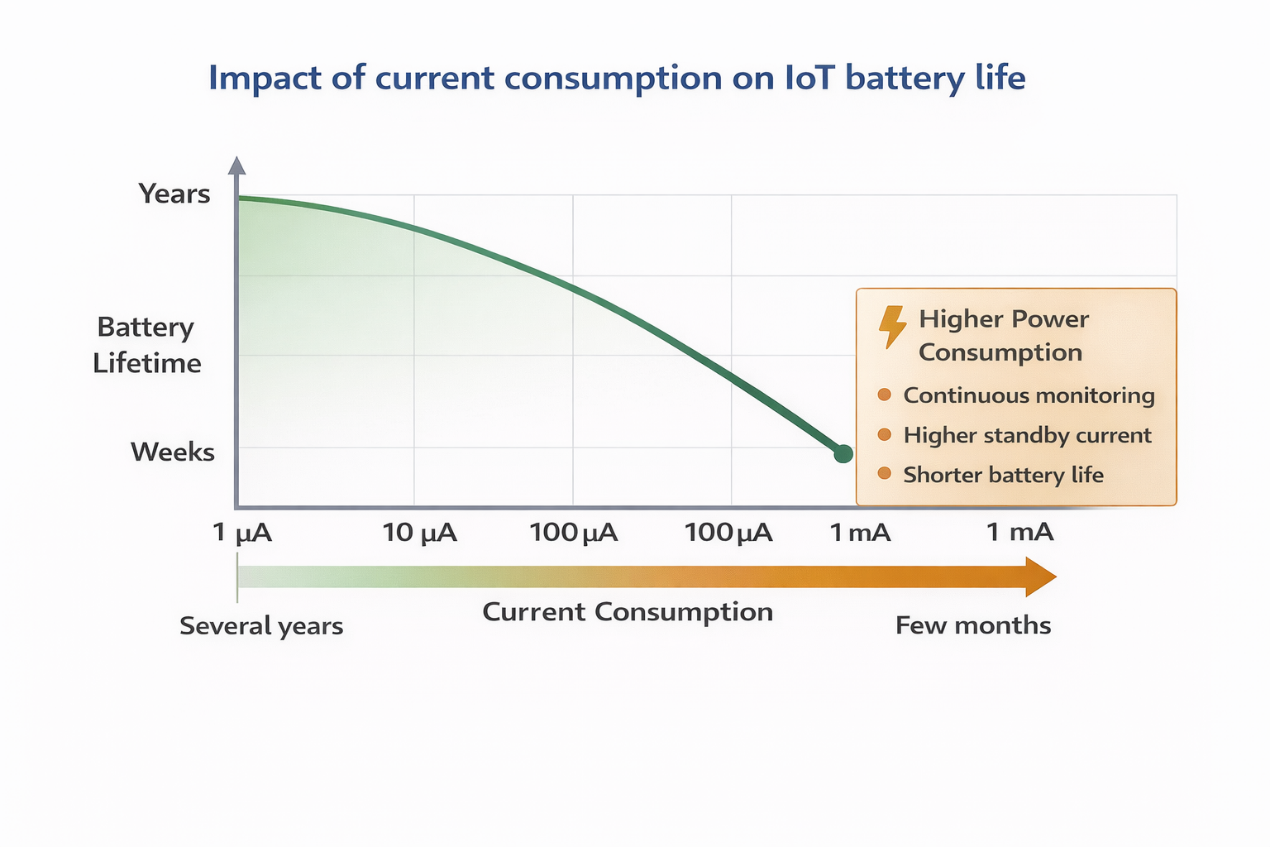
Even small reductions in standby current can dramatically extend the operational lifetime of a device.
The relationship between current consumption and battery lifetime is illustrated in the figure below.

3. Challenges of Continuous Motion Monitoring
Many IoT devices need to detect motion events such as movement, vibration, or tampering.
A common solution is to use electronic motion sensors such as: MEMS accelerometers, gyroscopes, and digital motion sensors.
These sensors provide detailed motion data and are widely used in smartphones and consumer electronics.
However, they also introduce a significant challenge for battery-powered devices.
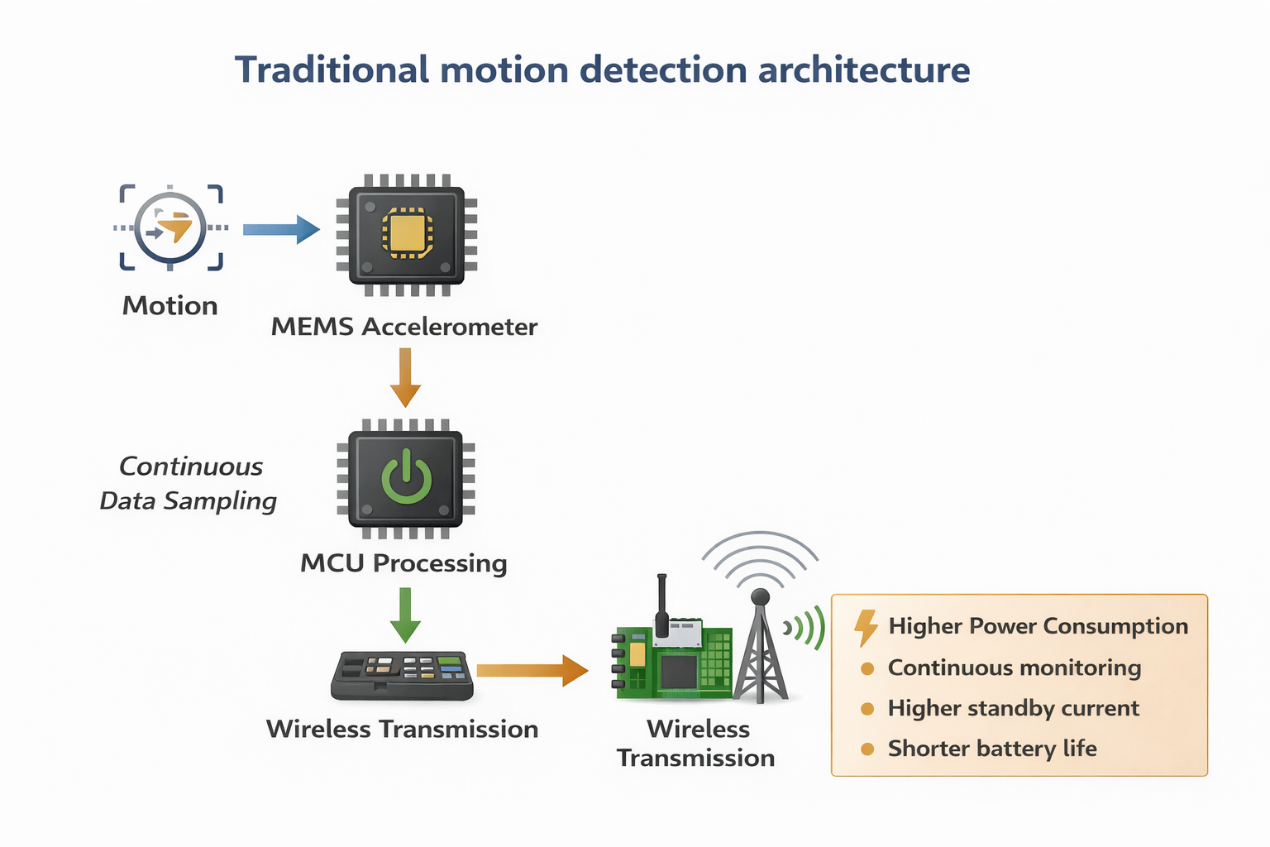
Even in low-power modes, these sensors typically consume tens to hundreds of microamps of current in the system.
For devices designed to operate for years on a small battery, this level of power consumption may be unacceptable.
The diagram below illustrates a typical continuous motion detection architecture.

4. How Mechanical Vibration Sensors Work
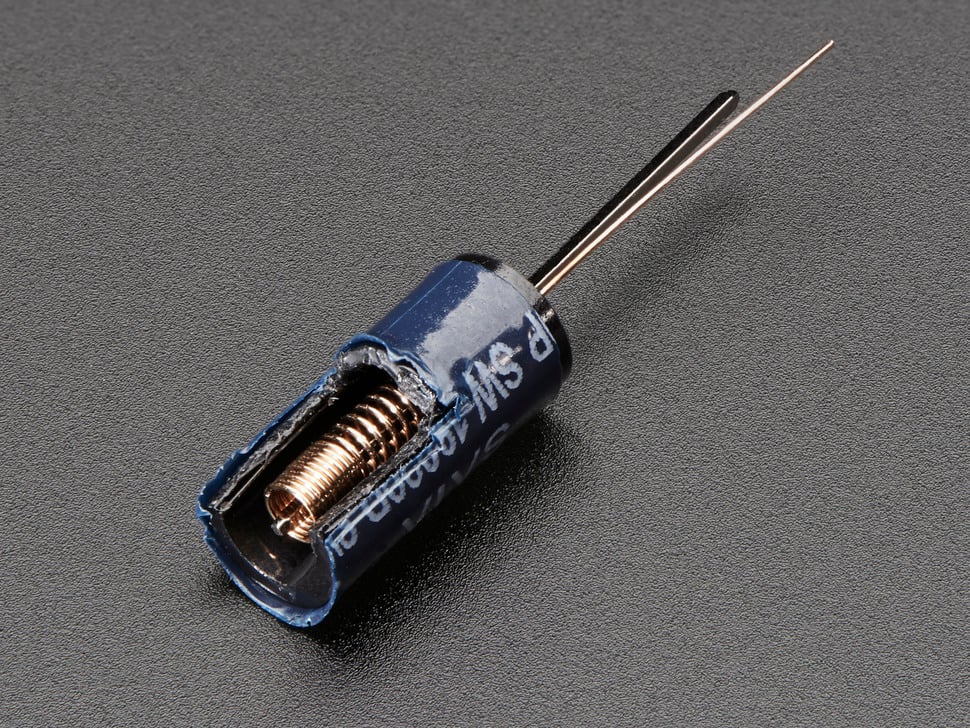
Mechanical vibration sensors operate based on a simple physical principle. Inside the sensor, a small conductive spring or metal element moves when vibration occurs.

When the device experiences motion or vibration: the internal element moves, the electrical contacts briefly close, and a signal is generated.
This signal can be used to trigger an interrupt in the microcontroller.
Unlike electronic sensors, mechanical vibration sensors do not require continuous power to monitor motion. They act as passive switches that only generate a signal when vibration occurs.
Because of this passive behavior, their standby power consumption is essentially zero.
This makes them ideal for ultra-low-power IoT systems where minimizing standby current is critical.
5. Event-Driven Wake-Up Architecture
One of the most effective ways to reduce power consumption in IoT systems is to use an event-driven architecture.
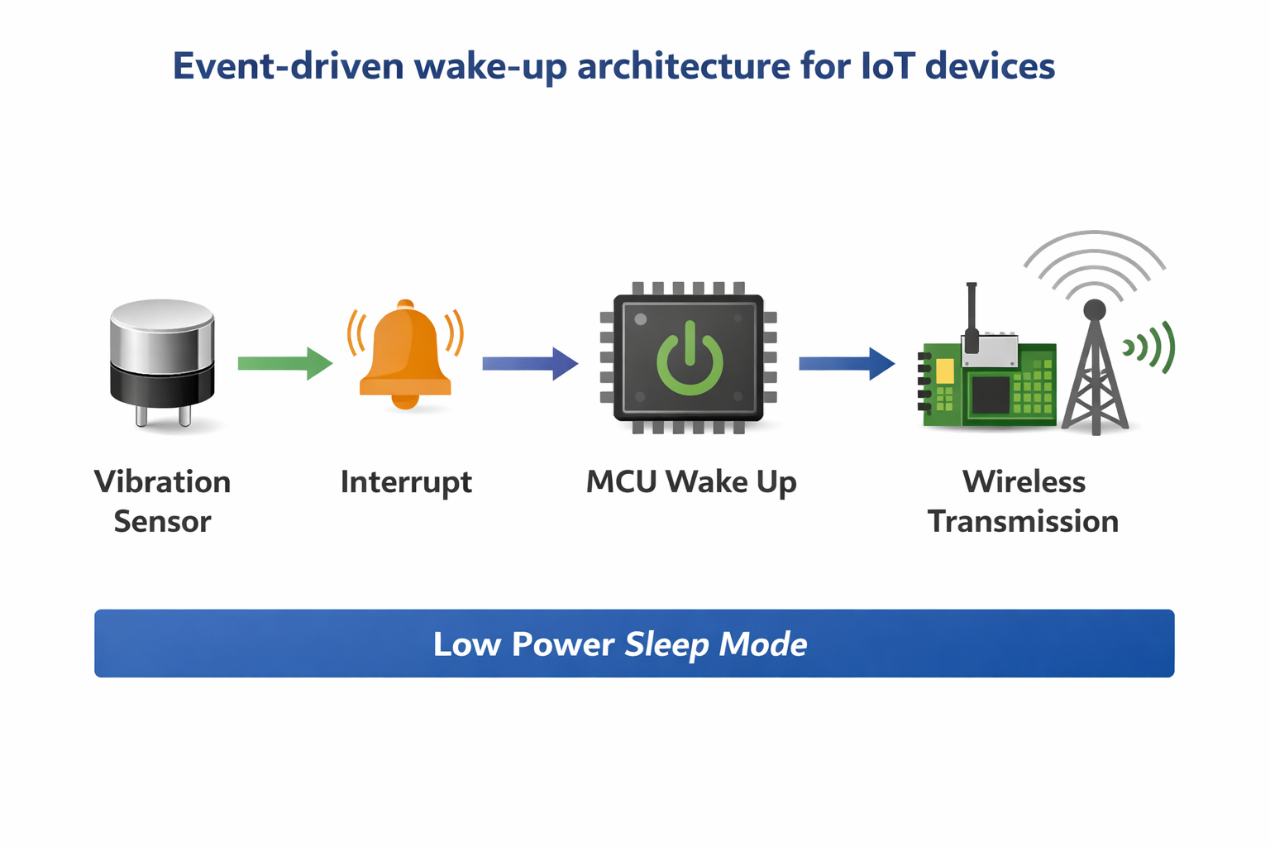
Instead of continuously monitoring sensors, the system remains in sleep mode until a trigger event occurs.
A typical low-power design may include: battery power supply, mechanical vibration sensor, ultra-low-power microcontroller, and wireless communication module.
During standby: the microcontroller enters deep sleep mode, the wireless module is powered down, and the vibration sensor passively monitors movement.
When vibration is detected: the sensor triggers an interrupt, the microcontroller wakes up, and the device processes the event or transmits data.
This architecture allows the system to remain inactive most of the time, dramatically reducing energy consumption.

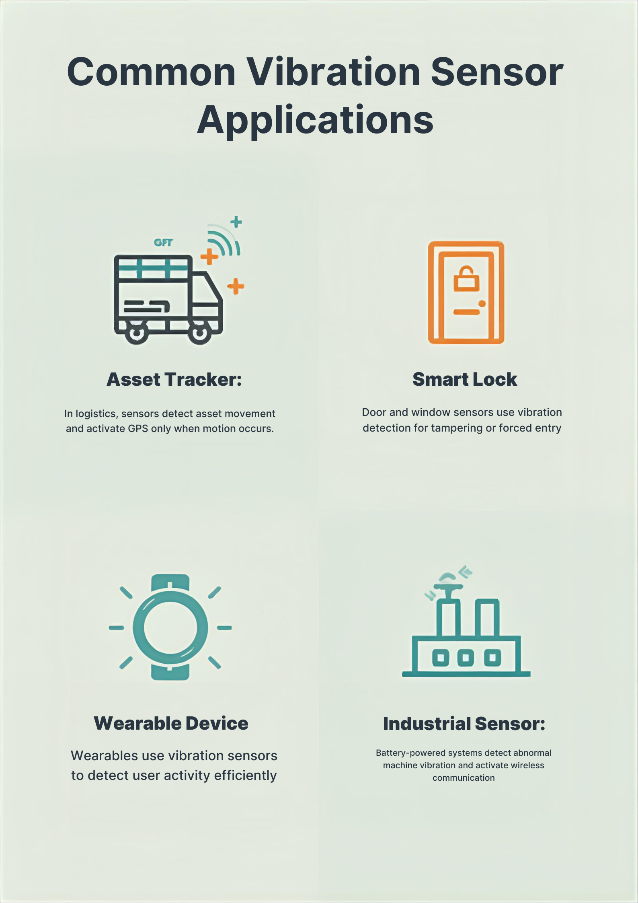
6. Typical Applications
Mechanical vibration sensors are widely used in applications that require long battery life and simple motion detection.
Asset Tracking: In logistics applications, vibration sensors can detect when an asset starts moving. The tracking device wakes up and activates GPS only when motion occurs.
Smart Home Security: Door and window sensors can use vibration detection to identify tampering or forced entry attempts.
Wearable Devices: Some wearable devices use vibration sensors to detect user activity without constantly running complex motion algorithms.
Industrial Monitoring: Battery-powered monitoring systems can detect abnormal machine vibration and activate wireless communication only when needed.

7. Advantages of Mechanical Vibration Sensors
Mechanical vibration sensors provide several benefits for IoT system designers.
Ultra-low standby power — They consume virtually no power while waiting for motion events.
Simple integration — They can be connected directly to microcontroller interrupt pins.
Fast response — They respond immediately to physical vibration.
Cost-effective solution — They are often less expensive than complex MEMS motion sensors.
Long operational lifetime — The absence of active electronics contributes to long-term reliability.
| Feature | Mechanical Sensor | MEMS Sensor |
|---|---|---|
| Standby Power | ~0 | 10-100 µA |
| Complexity | Low | High |
| Cost | Low | Higher |
8. Conclusion
As IoT technology continues to expand into new industries, the demand for energy-efficient devices is increasing.
Mechanical vibration sensors offer a simple and reliable way to extend battery life by enabling event-driven motion detection.
By allowing devices to remain in sleep mode until vibration occurs, these sensors significantly reduce standby power consumption.
For engineers designing long-lifetime IoT systems, vibration-based wake-up detection remains one of the most practical solutions for achieving ultra-low power operation.
Interactive Demo
Looking for ultra-low-power vibration sensors for your IoT device?